
Our
Whakapapa
The story of the Mangere Marae Church is a story of vision becoming reality. It has been an act of faith on the part of many people, a journeying, a searching. Far more than a building of bricks and mortar, glue laminated beams and long-run roofing iron, it has been a building of people - a journey undertaken with Christ as the guide.
The beginnings of Te Karaiti Te Pou Herenga Waka, the Mangere Marae Church
Te Karaiti Te Pou Herenga Waka is a Maori Anglican Church and Marae in Mangere that comes together to worship God and serve one another, our community and whanau through God’s love. We celebrate and strengthen whanau; we uphold the whakapapa of te reo and Tikanga passed to us by our tupuna; and we have a strong Whakapono (faith) built on scripture, tradition, reason and experience.
Overview of building history
The Church itself was built by Maori who came and settled in Mangere in the 1960s and wanted a place to worship. It is a labour of love and a testament to their faith and commitment.
Church Design
Te Karaiti Te Pou Herenga Waka – Christ the Reconciler. The name conveys the depth of how we view Christ in whom the whole of creation is reconciled.
The Reimagination of Sacred Space
This is a marae church, a building that represents the body of Christ. It is a place to welcome in, to embrace, to guard and protect all who enter here under the mantle of Christ’s love.
The maihi (the arms of the building) represent the welcoming arms of Christ. The head of Christ naturally fits at the apex of the building, the place of the tekoteko.
The Waka and Vaka (Canoes)Left waka/canoe was carved by Lloyd Popata. The Right waka/canoe was carved by a Tongan, Parneli Falaaku’a.They represent the community that built the church, who were of Māori and Tongan decent.
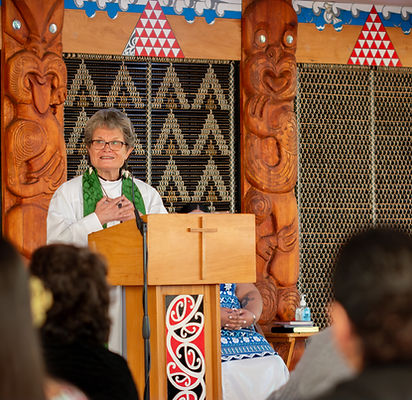
The Pou Pou
We have 8 pou at the front of our church – each one was carved by one of our parishioners.
On the left side of there are 4 pou with Biblical figures, and on the right, we have 4 pou with the Maori story of creation.
What do we understand about creation? The biblical narrative, God created everything including humanity. There are words on the far right poupou representing Adam and Eve.
On the far left poupou, called Te Puna o te Ora which means the “Spring of life”. If we understand creation to bring life into the world, that is what is being portrayed in this particular poupou.

The Maori creation story of Rangi and Papa represents our beginnings. Rangi and Papa are like Adam and Eve in that they symbolize origins, though they are not the same. Rangi and Papa were separated by their children, like Tangaroa. In the biblical creation story, each day of creation involved separation, such as light from darkness and sky from earth. Both stories have similarities in how they describe the origin of the world.
This poupou represents Mohi, or Moses, symbolizing the law. Elijah represents both the prophets and the law, two powerful elements in the first testament. The poupou shows a scroll, symbolizing the covenant between God and humanity. The carvings have specific meanings: the shoulder or hip shows strength and power, while carvings around the mouth indicate the person is an orator or that something sacred has come from their mouth.
On the other side is Ruatara, the gateway of the gospel, Te ara o te Rongopai. Ruatara was the second person Marsden communicated the gospel to. The first was Te Pāhi, who strengthened relationships with Australia but was killed in the Boyd massacre in 1809. Ruatara then rose to prominence and is featured in our Christian pou. Just as Moses is responsible for the law and covenant, Ruatara is responsible for bringing the gospel of Te Rongopai to this country. Oihi, Rangihoua, where Samuel Marsden preached his first sermon on Christmas Day 1814, is also carved here.
At the bottom, there are two kete (baskets) and the Bible. The Bible replaces one of the original three baskets of knowledge, known as Te Kete Tuatea, which is the basket of knowledge of evil and spells (makutu). This basket is left out as it is not appropriate. The remaining two kete, Te Kete Aronui and Te Kete Tuauri, represent sacred knowledge and the goodness of hope. Keeping these two and omitting the other shows how the gospel has influenced the understanding of the kete of wānanga. The Bible now replaces the kete of knowledge of black arts and curses (whaiwhaia).
This pou represents the Maori evangelists who spread the good news around the country. The most recognized is Piripi Taumata-a-Kura from Te Tai Rawhiti. He was captured by Ngāpuhi and taken north. Henry Williams told the Northern chiefs, "You are Christians, aren't you?" They replied, "Yes, of course, we are." Williams then said, "Well, you can't have slaves; you must let them go." After this, they were taught to read and write. Taumata-a-Kura took the baptismal name Piripi. The term "Kaikauhau" means preacher.
This pou not only represents Piripi Taumata-a-Kura but also all Maori who converted to Christianity and became messengers of the gospel throughout the country.
The other poupou is Mātenga Tūkareaho from Mahia. He went up north, converted to Christianity, and took the name Mātenga. He then returned and preached the first Christian message at Te Uhi, just outside of Wairoa.
These pou represent all the Māori who are the messengers of the gospel of the good news.
The fourth pou from the left has words that reference Peter, who professed Christ, saying, "You are the Messiah." Jesus responded, "You are Peter, and upon you, I shall build a kingdom." This pou represents the institutionalization of the Christian faith.
The fourth pou from the left represents Rota Waitoa, the first Maori to be ordained Deacon at St Paul's Church. Rota Waitoa is significant as he symbolizes the institutionalization of the Maori church in New Zealand. At the base of the pou are the words "Nga Waiata," referring to the Book of Common Prayer, and the Psalms of David, which became the Maori prayer book. It also features the Bishop's coat of arms (hammerhead formation) and represents ordination for Maori, indicating acceptance of all the church's demands, as exemplified by Rota Waitoa.
The middle pou was not touched by the master carver until sundown. It represents Christ, the center of all our beliefs. Our language speaks only of Te Karaiti (Christ), who is the resurrection and the reconciler. This pou emphasizes what is most important: Christ as the central figure in our faith.


